
Two Days a Week Is the Whole Prescription: Understanding Strength Training After 50 and How Physical Therapy Can Help


If you have taken a run at a jar lid and handed it to someone else, put a hand on the arm of a low sofa to get up, or needed two trips for groceries that used to take one, you have met the thing strength training after 50 is for. None of it is dramatic. It is a series of small negotiations that were not there a decade ago.
Here is the part that surprises people. In a study following 416,420 American adults, adding muscle-strengthening exercise to ordinary activity was associated with a further drop in the risk of dying during follow-up at one session a week. At seven sessions a week, that additional benefit was no longer there. The dose that mattered was far smaller than most people assume.
The good news? The World Health Organization recommends regular muscle-strengthening activity for every age group, and not one of the movements it means requires a gym, a membership, or anything you do not already own.
At Rooted Motion Physical Therapy, we believe the reason most people never start is that they picture the wrong thing. Let us look at what this actually involves, how much of it is enough, and what it does and does not change.
What Does Strength Training After 50 Actually Mean?
It means working a muscle against resistance until it is genuinely tired. That is the whole definition. The resistance can be a dumbbell, and it can just as easily be your own body weight, a bag of shopping, or a staircase.
What it does not mean is a barbell, a mirror, or a room full of people half your age. Those are one way of doing it, not the thing.
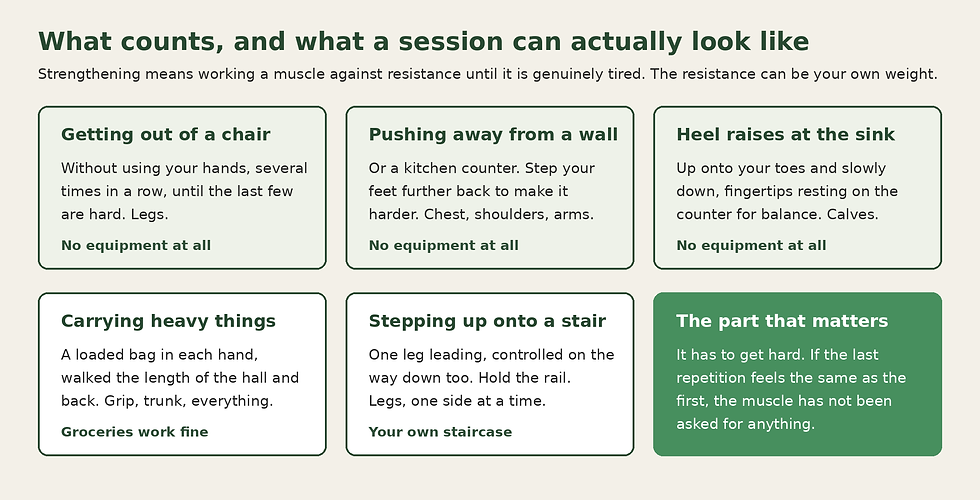
The condition in that last panel is the part people miss. A movement builds strength if it becomes hard. Ten easy repetitions of anything is a warm-up. The last two repetitions being a struggle is the signal that the muscle has been asked for something.
How Much Strength Training After 50 Is Enough?
Less than you would guess. That study of 416,420 adults is the clearest dose information available, and its authors put the minimum effective dose at one to two sessions a week. Beyond that the curve flattened: at seven sessions the additional benefit had gone.

Two things must be said about that number, and neither is a footnote.
The first is that it comes from watching what people reported doing and seeing who was still alive years later. That is an association, not proof the exercise caused the difference—people who strength-train differ from those who do not in ways no model fully accounts for.
The second matters more for how you use it. That number describes how long people lived. It does not describe how strong they got. Those are two different questions, and this study answers only the first—so treat one to two sessions a week as a floor worth clearing rather than as a target that guarantees any particular result in the mirror or on a staircase.
Imagine Winding a Mechanical Watch
A few turns of the crown runs a mechanical watch all day. Winding it more does not make it keep better time, and past full it simply stops taking. It does not reward enthusiasm, it rewards regularity.
The key idea. The benefit of strengthening is not stored up by doing more of it in one go. It comes from asking the muscle for something regularly—which is why a modest amount you keep doing beats an ambitious amount you abandon in March.
What Does It Actually Change?
The strongest evidence sits in older adults who have already lost meaningful muscle. A network meta-analysis of 42 trials in 3,728 people found, at high or moderate certainty, that resistance exercise—alone, with added nutrition, or combined with aerobic and balance work—was among the most effective things available for quality of life. Resistance combined with balance training improved walking speed by an amount the researchers judged clinically meaningful.
Two caveats travel with that. Those participants already had diagnosed muscle loss, with a median age of 73, so it is not a study of healthy fifty-year-olds. And the median follow-up was twelve weeks, which tells you about starting rather than about staying.
What It Does Not Do
On its own, it is not considered enough to prevent falls.
This matters because the two get run together constantly. The 2025 fall-risk guideline from the American Physical Therapy Association's geriatrics section recommends multicomponent exercise including progressive, genuinely challenging balance training—and does not recommend resistance training on its own for fall prevention, on the grounds of limited benefit.
Strength is worth having for its own reasons. If falling is the worry, balance work has to be in the plan as well, and anyone selling you strengthening as fall prevention is ahead of the evidence.
Can You Do This at Home?
Yes, and better established than most people assume. A review of 21 randomized trials in 4,053 community-dwelling adults over 60 found unsupervised home resistance training improved lower-limb strength, rising from a chair, and balance, against carrying on as usual.
The same review is careful about what did not move: grip strength, walking speed and the standard timed performance tests showed no clear benefit, and neither did quality of life or the rate of falls. The authors call it preliminary and modest, and note that adherence averaged 67 percent—the single biggest limit on whether any of it works.
What is less settled is how short a session can be. A pilot had 38 adults averaging 70 do nine-minute sessions at home: everyone stayed in, adherence ran 81 to 97 percent, and there were two adverse events across 1,317 sessions. The format is practical and safe. It was not designed to show it works, and its authors say so.
Everyday Tips That Can Help
Start with two sessions a week and protect them. Consistency over months beats intensity over a fortnight.
Use what is in the room. A chair, a counter and a staircase cover most of it.
Make it hard at the end, not the beginning. If the last repetition feels like the first, add repetitions or slow them down.
Some muscle soreness a day or two after a new routine is common, and it usually settles as you get used to the work.
Add balance work separately if steadiness is the thing you are worried about.
If something hurts in a joint rather than aching in a muscle, that is worth having looked at rather than pushing through.
The Rooted Motion Difference
The hardest part of starting is not the effort. It is knowing what is enough, what is too much, and what to do about the knee or shoulder that already objects. We provide one-on-one mobile care throughout Richmond, Henrico, Chesterfield and Midlothian, so the program gets built in the room where you will do it.
Working with us, you can expect:
A one-on-one assessment of what you can currently do, measured rather than guessed.
A starting point matched to that, not to a generic beginner program.
Movements built around your own furniture, stairs and space.
A plan for making things harder over time, so progress does not stall at week three.
Balance work included where it is warranted, and named as separate where it is not.
Honest discussion of what the evidence supports and where it runs out.
Convenient concierge mobile physical therapy delivered where you are.
Because this is not just about getting stronger—it is about keeping the ordinary parts of your life easy for longer.
Ready to Start Without Guessing?
Whether you have never lifted anything deliberately, or you used to and stopped somewhere around 2015, the beginning is the part worth getting right—and a plan built around what you can currently do is what keeps it from becoming another thing you abandoned.
Contact Rooted Motion Physical Therapy to schedule your one-on-one evaluation and begin a personalized plan.
Research Used for This Article
Bull FC, Al-Ansari SS, Biddle S, Borodulin K, Buman MP, Cardon G, Carty C, Chaput JP, Chastin S, Chou R, Dempsey PC, DiPietro L, Ekelund U, Firth J, Friedenreich CM, Garcia L, Gichu M, Jago R, Katzmarzyk PT, Lambert E, Leitzmann M, Milton K, Ortega FB, Ranasinghe C, Stamatakis E, Tiedemann A, Troiano RP, van der Ploeg HP, Wari V, Willumsen JF. World Health Organization 2020 guidelines on physical activity and sedentary behaviour. British Journal of Sports Medicine. 2020;54(24):1451-1462. DOI
Coleman CJ, McDonough DJ, Pope ZC, Pope CA. Dose-response association of aerobic and muscle-strengthening physical activity with mortality: a national cohort study of 416 420 US adults. British Journal of Sports Medicine. 2022;56(22):1277-1285. DOI
Shen Y, Shi Q, Nong K, Li S, Yue J, Huang J, Dong B, Beauchamp M, Hao Q. Exercise for sarcopenia in older people: A systematic review and network meta-analysis. Journal of Cachexia, Sarcopenia and Muscle. 2023;14(3):1199-1211. DOI
Fyfe JJ, Dalla Via J, Jansons P, Scott D, Daly RM. Feasibility and acceptability of a remotely delivered, home-based, pragmatic resistance 'exercise snacking' intervention in community-dwelling older adults: a pilot randomised controlled trial. BMC Geriatrics. 2022;22(1):521. DOI
Kirk-Sanchez N, McDonough C, Avin KG, Blackwood J, Hanke TA. Physical Therapy Management of Fall Risk in Community-Dwelling Older Adults: An Evidence-Based Clinical Practice Guideline From the American Physical Therapy Association - Geriatrics. Journal of Geriatric Physical Therapy. 2025;48(2):62-87. DOI
Mañas A, Gómez-Redondo P, Valenzuela PL, Morales JS, Lucía A, Ara I. Unsupervised home-based resistance training for community-dwelling older adults: A systematic review and meta-analysis of randomized controlled trials. Ageing Research Reviews. 2021;69:101368. DOI
Educational disclaimer: This article is for educational purposes and is not a substitute for an individual evaluation by a licensed healthcare professional. Seek prompt medical evaluation for severe pain, significant weakness, numbness, or symptoms following trauma.


Comments