
The First Cold Snap and Everything Aches: Understanding Cold Weather Joint Pain and How Physical Therapy Can Help


If you have ever woken on the first raw morning of the season and found your knees stiffer, your hands slower to open and the stairs asking more than they did in September, you are describing something most people with an achy joint recognize at once. Cold weather joint pain is one of the most widely shared beliefs in musculoskeletal health, and in Richmond it arrives on schedule every October.
Here is what makes it interesting. When researchers pooled eleven studies covering more than fifteen thousand people and twenty-eight thousand separate pain events in 2024, they found no association between temperature, humidity, air pressure or rainfall and the risk of a flare in knee, hip or back pain, or in rheumatoid arthritis. An analysis of eleven million medical visits by over a million and a half older Americans found no link between rainfall and visits for joint or back pain either.
The good news? Whatever the weather is or is not doing to your joints, the things that most reliably change how a joint feels in November are things you can influence.
At Rooted Motion Physical Therapy, we believe you deserve the real answer rather than the comfortable one. Let's explore what cold weather joint pain really is, what the research has and has not found, and how physical therapy can help you get through a Virginia winter doing what you love.
What Is Cold Weather Joint Pain?
Cold weather joint pain is not a diagnosis. It is a pattern people describe: an existing joint problem—usually osteoarthritis, an old injury or an inflammatory arthritis—that seems to flare when the weather turns. The weather is being blamed for the day-to-day ups and downs rather than for the condition itself.
It is not a fringe belief: across six European countries, 67 percent of older adults with osteoarthritis said the weather affected their pain. One finding there is worth sitting with. Those who called themselves weather-sensitive reported more pain overall, and the difference held after other explanations were accounted for. The label may say less about the forecast than about how much the joint has been asking of you.
Why Does the Research Keep Coming Up Empty?
Because of how averages work, and this is the part that changes the whole conversation.
Imagine a Thermostat in a Crowded Room
Picture a meeting room with twenty people and one thermostat on the wall. Half the room is too cold and has put a jacket on; half is too warm and has rolled up their sleeves. The thermostat reads a comfortable seventy-one degrees, and by that measurement nobody has a problem at all. It is not broken and not lying—it is doing what it was built to do, which is report one number for a room full of people who disagree.
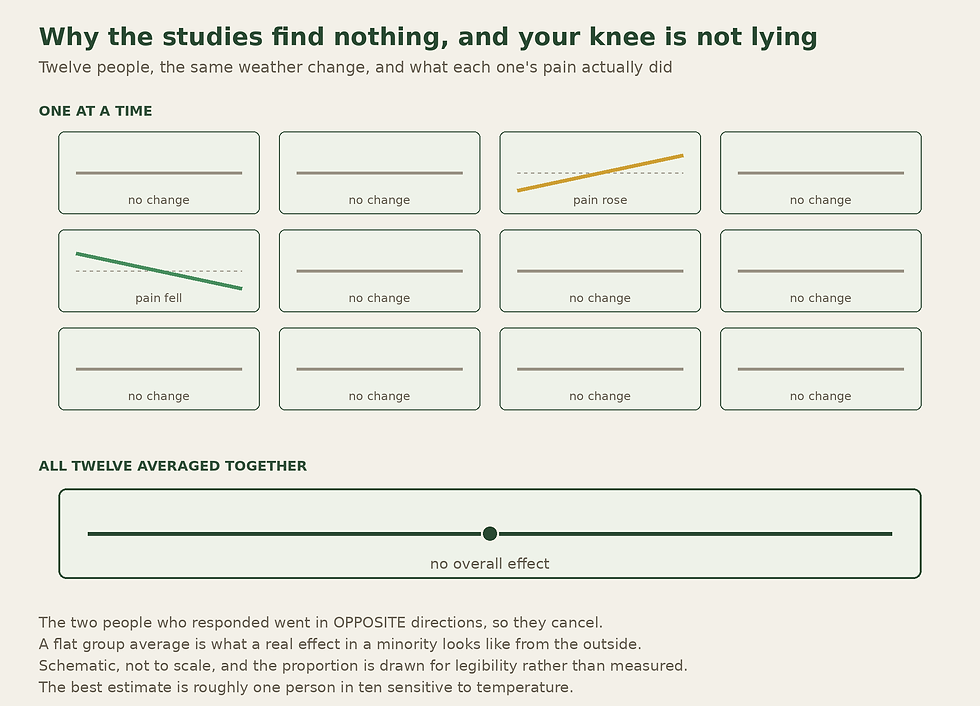
That is what the weather research looks like up close. One large study tracked thousands of people with chronic pain day by day through a smartphone app and found roughly one person in ten genuinely sensitive to temperature, around one in twenty-five to humidity and about one in fifty to air pressure. People volunteered for that study, so the sensitive are probably over-represented in it. The crucial detail is that the direction differed from person to person.
That is not one study's quirk. A separate study following 333 women with fibromyalgia daily for four weeks found the same thing from the other direction: in a fifth of the analyses patients differed from one another in how their symptoms tracked the weather, with high pain reported at both low and high air pressure depending on the person. Those authors concluded there was more evidence against a single, uniform weather effect than for one.
Average those people together and the effect disappears—not because it was never there, but because it pointed in opposite directions and canceled itself out.
The studies that do find a link tend to find a very small one. A two-year study of 222 people with hip osteoarthritis found humidity and air pressure genuinely associated with their symptoms—and calculated that those weather variables accounted for one percent or less of the difference in how much pain people had. The authors called that not clinically relevant.
The key idea
A group average can sit flat while individual people are moving in opposite directions. That is what a real effect in a minority looks like from the outside. Nothing about it makes your experience less real—it means the weather is not the lever worth pulling.
Why the Phrase "Cold Weather Joint Pain" May Be Misleading Here
The name points at cold, and locally the evidence points somewhere else. A seven-year study of emergency visits for pain across North Carolina split the state into mountains, Piedmont plateau and coastal plain. In the Piedmont—the region Richmond, Midlothian and Henrico sit in—the highest rates came on moist tropical and moist moderate air masses, and polar air was associated with the fewest.
Warm and sticky, in other words, not cold and crisp. That study counts visits rather than pain and North Carolina is not Virginia, so it is a signpost rather than a conclusion—but it is the closest study of its kind to this area, and it points the opposite way to the folklore.
The single positive finding among the case-crossover studies—the design that compares a person against themselves—was not about cold either. In people with hip osteoarthritis it was how much the temperature swung over the previous three days that tracked with flares, while the high, the low, the humidity, the rainfall and the pressure came up empty. The change, possibly. The cold, apparently not.
That came from one study of about a hundred and thirty people and was the only signal among six weather measures tested. The larger study, following 810 people across six countries, specifically tested whether the change from one day to the next mattered and found that it did not. So it is a lead worth following rather than something to plan around.
Is There Anything the Evidence Is Clear About?
Yes, and it is worth knowing because it is treated differently.
Gout is the exception. A study following 632 adults with gout found higher temperatures carried roughly 40 percent greater odds of an attack, and hot combined with dry roughly doubled the odds. The suspected reason is ordinary dehydration concentrating the blood, which makes drinking enough in hot, dry weather the one piece of weather-related advice in this article with a mechanism behind it.
One caution matters more than the rest of this article. A gout flare and a joint infection can look the same from the outside—one joint, hot, red, swollen and painful to the lightest touch—and they are not treated the same way at all. A joint infection is urgent. Fever is absent in a large share of confirmed cases, so feeling well otherwise is not reassurance, and having gout already does not rule it out, because the two can occur together.
So a single joint that turns hot, red and swollen—over hours or over a couple of days—is a reason to be seen the same day rather than to reach for an explanation. That is a medical question rather than a physical therapy one.
What Does the Research Recommend?
We could not find a clinical guideline that recommends anything about managing the weather, and the reason appears to be that there is nothing to recommend.
We looked for studies testing whether anything a person does about the weather helps—keeping a joint warm, dressing differently, timing activity around the forecast—and found none. That is an honest gap, better said plainly than filled with advice that sounds sensible and has never been tested. What does have evidence behind it is everything on the other list.

What Actually Changes How a Joint Copes
A joint that is well supported and used regularly tolerates a bad week better than one that is not. The work is unglamorous, and it is the part with research behind it:
Strength in the muscles that cross the joint, built gradually and kept up all winter.
Regular movement across the week rather than a burst on the one good day.
Pacing after a flare, so a hard day does not cost two weeks of deconditioning.
Sleep, which affects how much pain a given amount of loading produces.
How much you ask of the joint, and how often.
Warming up for longer when you feel stiff. Stiffness is a reason to move sooner, not later.
Moving the activity indoors rather than canceling it when the weather stops you.
None of that is weather-dependent, which is the point.
Is Some Pain During Exercise Okay?
Generally, yes. Working into mild discomfort is usually acceptable and often necessary, and a common rule of thumb is to keep pain at a level you would call mild rather than sharp. The more useful check is the next morning: if the joint has settled back to its usual baseline within about twenty-four hours the dose was reasonable, and if it is still noticeably worse that is information rather than failure.
If you are not sure where your line sits, that is worth working out alongside a physical therapist rather than guessing alone.
One Thing Worth Trying
Keep a note of difficult days for a month, including what you did the day before and not only what the sky did. If you genuinely are one of the people who responds to the weather, your own record is better evidence about you than the published research, which has already averaged you away.
Why Choose Physical Therapy Early?
Because the useful question is not whether the forecast is to blame, but what the joint can currently tolerate and what would have to change for it to tolerate more.
An evaluation establishes which joint is driving the problem and what a sensible progression looks like. A winter spent avoiding activity because of how the joint felt on its worst three days is a winter of lost capacity, and that loss is what makes next October harder.
The Rooted Motion Difference
We work with you one-on-one, in your own home, on a plan built around your joints and the things you want to keep doing. Here is what to expect:
A full one-on-one evaluation with a licensed physical therapist, never handed off to an aide.
A clear explanation of what is driving your symptoms, in plain language.
A program built for your current capacity rather than a printed handout.
Progressions that change as you change.
Honest answers about what the evidence does and does not support.
Convenient concierge mobile physical therapy delivered where you are.
Care that fits your life in Richmond, Midlothian and Henrico.
Because recovery is not just about getting through a cold snap—it is about helping you get back to living your life.
Ready to Get Back to the Activities You Love?
Whether your stiffness shows up on the stairs, in the garden or getting out of the car on a raw morning, you do not have to navigate it alone, and you do not have to wait for spring.
Evidence-based physical therapy builds the strength and tolerance that make a difficult week an inconvenience rather than a setback.
Move Better. Live Rooted. Contact Rooted Motion Physical Therapy to schedule your one-on-one evaluation and begin a personalized plan.
Research Used for This Article
Ferreira ML, Hunter DJ, Fu A, Raihana S, Urquhart D, Ferreira PH. Come rain or shine: Is weather a risk factor for musculoskeletal pain? A systematic review with meta-analysis of case-crossover studies. Seminars in Arthritis and Rheumatism. 2024;65:152392. DOI
Jena AB, Olenski AR, Molitor D, Miller N. Association between rainfall and diagnoses of joint or back pain: retrospective claims analysis. BMJ. 2017;359:j5326. DOI
Yimer BB, Schultz DM, Beukenhorst AL, Lunt M, Pisaniello HL, House T, Sergeant JC, McBeth J, Dixon WG. Heterogeneity in the association between weather and pain severity among patients with chronic pain: a Bayesian multilevel regression analysis. Pain Reports. 2022;7(1):e963. DOI
Dixon WG, Beukenhorst AL, Yimer BB, Cook L, Gasparrini A, El-Hay T, Hellman B, James B, Vicedo-Cabrera AM, Maclure M, Silva R, Ainsworth J, Pisaniello HL, House T, Lunt M, Gamble C, Sanders C, Schultz DM, Sergeant JC, McBeth J. How the weather affects the pain of citizen scientists using a smartphone app. NPJ Digital Medicine. 2019;2:105. DOI
Wang L, Xu Q, Chen Y, Zhu Z, Cao Y. Associations between weather conditions and osteoarthritis pain: a systematic review and meta-analysis. Annals of Medicine. 2023;55(1):2196439. DOI
Ferreira ML, Zhang Y, Metcalf B, Makovey J, Bennell KL, March L, Hunter DJ. The influence of weather on the risk of pain exacerbation in patients with knee osteoarthritis - a case-crossover study. Osteoarthritis and Cartilage. 2016;24(12):2042-2047. DOI
Fu K, Metcalf B, Bennell KL, Zhang Y, Deveza LA, Robbins SR, Ferreira ML, Hunter DJ. Association of weather factors with the risk of pain exacerbations in people with hip osteoarthritis. Scandinavian Journal of Rheumatology. 2021;50(1):68-73. DOI
Timmermans EJ, Schaap LA, Herbolsheimer F, Dennison EM, Maggi S, Pedersen NL, Castell MV, Denkinger MD, Edwards MH, Limongi F, Sanchez-Martinez M, Siviero P, Queipo R, Peter R, van der Pas S, Deeg DJH. The Influence of Weather Conditions on Joint Pain in Older People with Osteoarthritis: Results from the European Project on OSteoArthritis. The Journal of Rheumatology. 2015;42(10):1885-1892. DOI
Timmermans EJ, van der Pas S, Schaap LA, Sanchez-Martinez M, Zambon S, Peter R, Pedersen NL, Dennison EM, Denkinger M, Castell MV, Siviero P, Herbolsheimer F, Edwards MH, Otero A, Deeg DJH. Self-perceived weather sensitivity and joint pain in older people with osteoarthritis in six European countries: results from the European Project on OSteoArthritis (EPOSA). BMC Musculoskeletal Disorders. 2014;15:66. DOI
Elcik C, Fuhrmann CM, Sheridan SC, Mercer AE, Sherman-Morris K. Geographical variability in the relationship between synoptic weather type and emergency department visits for pain across North Carolina. International Journal of Biometeorology. 2022;66(3):559-572. DOI
Dorleijn DMJ, Luijsterburg PAJ, Burdorf A, Rozendaal RM, Verhaar JAN, Bos PK, Bierma-Zeinstra SMA. Associations between weather conditions and clinical symptoms in patients with hip osteoarthritis: a 2-year cohort study. Pain. 2014;155(4):808-813. DOI
Bossema ER, van Middendorp H, Jacobs JWG, Bijlsma JWJ, Geenen R. Influence of weather on daily symptoms of pain and fatigue in female patients with fibromyalgia: a multilevel regression analysis. Arthritis Care & Research. 2013;65(7):1019-1025. DOI
Neogi T, Chen C, Niu J, Chaisson C, Hunter DJ, Choi H, Zhang Y. Relation of temperature and humidity to the risk of recurrent gout attacks. American Journal of Epidemiology. 2014;180(4):372-377. DOI
Educational disclaimer: This article is for educational purposes and is not a substitute for an individual evaluation by a licensed healthcare professional. A single joint that becomes hot, red and painful over hours or over a couple of days warrants same-day assessment rather than being attributed to the weather. Seek prompt medical evaluation if a joint is hot, red, markedly swollen or accompanied by fever. Seek care promptly for severe pain, significant weakness or new numbness.


Comments