
One Tendon, Two Different Rules: Understanding Achilles Tendon Pain Treatment and How Physical Therapy Can Help


If you have ever felt the back of your leg grip on the first stair of the morning, warmed out of the soreness by the second game and paid for it the next day instead, flinched pulling on a sock, or run a thumb up from your heel and felt a thickening that was not there last season, you have met Achilles tendon pain. The right Achilles tendon pain treatment turns on a question you may never have been asked: exactly where does it hurt?
Here is what surprises people. Two problems share this tendon's name and want opposite things about one thing. Pain in the cord itself generally responds to loading it hard. Pain right down at the bone generally responds to loading it just as hard while keeping the ankle out of its end-range upward bend. Roughly a third of cases are the second kind—so the calf stretch you were handed may be the one thing that particular tendon does not want.
The good news? Both kinds respond to exercise, most people never need surgery, and the difference between the plans is position rather than effort.
At Rooted Motion Physical Therapy, we believe a plan that names your actual problem beats one that names your tendon. Let us look at what Achilles tendon pain treatment involves and why location changes it.
Why Does Achilles Tendon Pain Treatment Depend on Where It Hurts?
The Achilles is the thick cord joining your calf muscles to your heel bone, and pain here is described by where it sits.
Midportion pain sits in the cord itself, roughly two to six centimetres above the heel. You can usually pinch the sore part between finger and thumb.
Insertional pain sits at the very bottom, where the tendon fastens to the bone. It is often tender against the back of a stiff shoe.
They can occur together, and a clinician confirms which. The distinction matters because at the bottom, the tendon has a bone to contend with.

Imagine a Garden Hose
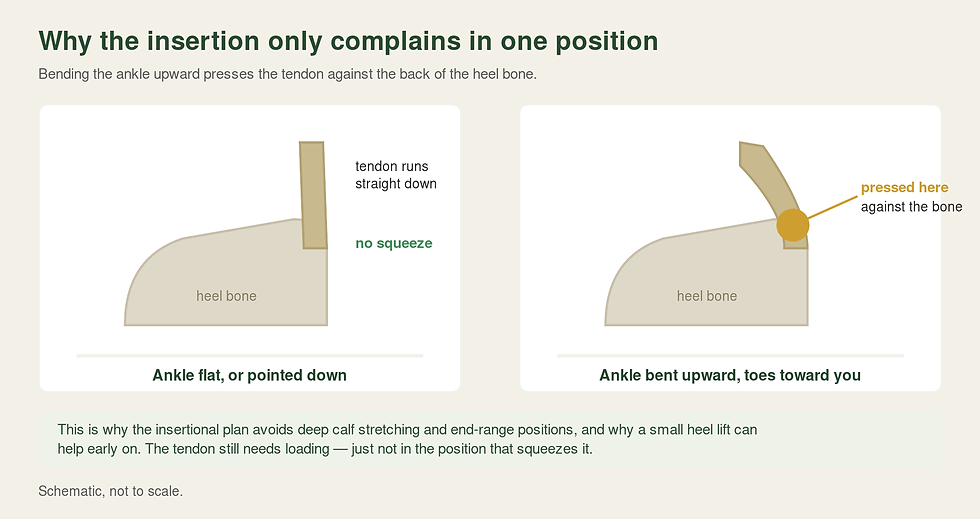
A hose lying along the ground carries water perfectly well. Fold it over the lip of a step and, past a certain angle, it pinches—almost nothing for a while, then a kink. The hose is not damaged. It is squeezed at one spot, in one position.
The same thing happens at the bottom of the tendon as your ankle bends upward, and it has been measured: researchers placing pressure sensors in donated legs found pressure rising exponentially with upward bend, highest of all in the deepest part of the insertion. A thickened tendon gets more of that squeeze for the same work. That study measured pressure rather than pain, so the treatment implication still needs testing—but the steep curve is real, not a metaphor.
The key idea. The tendon is not broken and it is not too weak to work. It is compressed in one particular ankle position—so the loading stays and the position changes.
Common Symptoms
Stiffness in the back of the leg or heel for the first minutes after rest.
Pain that warms up during activity and returns harder the next day.
Tenderness squeezing the tendon, or where a shoe heel presses.
A thickened or lumpy feeling along the cord.
Difficulty with hills, stairs or pushing off for a wide ball.
Why Rest Alone Usually Does Not Work
“I have been resting it for months, but it still hurts.”
Rest settles the irritation and does very little for the capacity. A living systematic review pooling twenty-nine randomized trials found essentially any active treatment beat waiting at three months, with no clinically meaningful difference between the active treatments—so doing something structured matters more than picking the perfect something. That review is also honest about itself: twenty-two of its twenty-nine trials were at high risk of bias, none at low risk, and it could not analyse the insertional kind at all, because the trials were not there.
What Does the Research Recommend for Achilles Tendon Pain Treatment?
For the midportion there is a current clinical practice guideline, and its recommendation is heavier than most people expect: loading at loads as high as you can tolerate, at least three days a week, first-line. It also states clinicians are not restricted to eccentric exercise—the slow-lowering work many people were handed as the whole programme. Function tends to improve meaningfully by twelve weeks.
A systematic review across the Achilles and patellar tendons found only limited and conflicting evidence that isolating that lowering component beats other loading. It also put non-response to eccentric work alone at up to 45 percent. That figure depends on how long people are followed: roughly one in five in short trials, and nearer three in five still carrying symptoms on long follow-up of the classic protocol. This is often slower and less complete than people are led to expect.
For the insertional kind the evidence is thinner, though no longer a single study: a 2025 major review recommends this same approach and notes that full-range protocols have lower success rates. The direct test is one randomized trial of 42 sport-active adults. Both did the same progressive programme; one kept the ankle out of end-range bend, skipped calf stretching and used a heel lift, the other worked into full bend. The limited-bend group improved more at twelve and twenty-four weeks and reported markedly higher satisfaction.
Two details travel with it. The average benefit cleared the threshold patients notice while the uncertainty around it dipped below it, so the direction is more reliable than the size. And calf strength improved about equally in both groups: the group that felt better was not the stronger one, it was the one loading in a different ankle position.

How Much Should It Hurt While You Load It?
Some discomfort during tendon work is expected and is not a sign of damage. The trial above used a practical rule worth borrowing.
Keep pain moderate rather than sharp during the exercise itself.
Check it again one hour afterwards, and again the next morning.
Compare weeks, not days. Week-on-week stability says the dose is right.
Add difficulty only once a stage has been comfortable for a fortnight.
A temporary increase in symptoms is the commonest side effect and generally settles. Progress is usually fastest early and then flattens, so a plateau at three months is a normal shape rather than a failure.
Do Shockwave, Injections, or Surgery Help?
Shockwave looks contradictory in the literature until you notice what it was compared against.
Older reviews did report a benefit—but they compared it against active treatment or against nothing. Put it against a convincing dummy treatment instead, both groups doing the same exercises underneath, and the difference disappears. Two randomized trials found exactly that, one double-blinded with 119 participants, and a 2026 review grading nine trials reached the same conclusion for both locations. The lesson generalises: a treatment can look effective against nothing and do very little against a convincing placebo.
Two caveats. Adverse events were numerically higher in the shockwave groups and the review recorded two Achilles ruptures after focused shockwave; and its authors note most estimates rest on low-certainty evidence, with one exploratory signal—possible short-term relief when symptoms have lasted under a year—that is a hypothesis, not a recommendation. Injections and surgery sat outside the midportion guideline's scope; surgery is generally considered only after a loading programme has had a fair trial, measured in months.
What About the Ruptures You Hear About on the Court?
A rupture is a different injury, not the next stage of this one—a sudden tear, usually with a bang you can hear, needing same-day medical assessment.
The reassuring number first. In a large US records analysis about 4 percent of people diagnosed with Achilles tendinopathy later ruptured—so roughly 96 percent did not. A real risk factor and a weak individual predictor, from a database that counted codes rather than examined people.
The racquet-sport picture is striking. Among more than a thousand surgically repaired ruptures, those sustained playing pickleball happened at a median age of 60 against 45 for tennis, and 82.5 percent were in over-fifties—a comment on who has taken up pickleball rather than on your personal risk, since nobody counted the players who came away fine. And the honest limit: nothing here shows treating a sore tendon prevents a rupture, because tendon trials measure pain and function. Separately, fluoroquinolone antibiotics and corticosteroids are associated with tendon rupture and worth raising with your doctor.
Everyday Tips That Can Help
Change one thing at a time, or the cause becomes impossible to find.
If the pain sits at the bone, go easy on deep calf stretching and steep downhill walking. Both push the ankle into the position that compresses it.
A small heel lift in both shoes can take the edge off insertional pain early—treat it as temporary relief, since alone it does far less than loading. Check the heel counter too: a stiff one presses straight onto a sore insertion.
Keep walking. Tendons object to sudden jumps in loading, not to activity.
The Rooted Motion Difference
Tendon rehabilitation succeeds or fails on details, and the details are individual. The right starting load, the right ankle position and the right moment to progress are not things a printed sheet can decide for you.
Working with us, you can expect:
A one-on-one evaluation establishing where in the tendon your pain sits.
A loading plan matched to that location, not to the diagnosis label.
Clear rules on acceptable discomfort, and when to progress.
Honest discussion of what the evidence supports and where it runs out.
Footwear and activity adjustments built around your actual week.
A return-to-sport plan built on criteria rather than dates.
Convenient concierge mobile physical therapy delivered where you are.
Because recovery is not just about healing a tendon—it is about helping you get back to living your life.
Ready to Get Back on Court?
Whether this started in the first week of a league season, on a hill you added to your usual walk, or on a staircase you have climbed for years, you do not have to navigate recovery alone. Pain in the back of the heel has a habit of being managed quietly, by avoidance, for a very long time—and a structured loading plan matched to where it sits is the approach with the best support behind it.
Ready to move better and live rooted? Contact Rooted Motion Physical Therapy to schedule a one-on-one evaluation and begin a personalized Achilles tendon recovery plan.
Research Used for This Article
Chimenti RL, Neville C, Houck J, Cuddeford T, Carreira D, Martin RL. Achilles pain, stiffness, and muscle power deficits: midportion Achilles tendinopathy revision 2024. Journal of Orthopaedic & Sports Physical Therapy. 2024;54(12):CPG1-CPG32. DOI
Pringels L, Capelleman R, Van den Abeele A, Burssens A, Planckaert G, Wezenbeek E, Vanden Bossche L. Effectiveness of reducing tendon compression in the rehabilitation of insertional Achilles tendinopathy: a randomised clinical trial. British Journal of Sports Medicine. 2025;59(9):640-650. DOI
Demangeot Y, O'Neill S, Degache F, Rapin A, Asgher U, Alfredson H, et al. Exercise parameters to consider for Achilles tendinopathy: a modified Delphi study with international experts. British Journal of Sports Medicine. 2025;59(19):1337-1349. DOI
van der Vlist AC, Winters M, Weir A, Ardern CL, Welton NJ, Caldwell DM, Verhaar JAN, de Vos RJ. Which treatment is most effective for patients with Achilles tendinopathy? A living systematic review with network meta-analysis of 29 randomised controlled trials. British Journal of Sports Medicine. 2021;55(5):249-256. DOI
Alsulaimani B, Perraton L, Vallance P, Powers T, Malliaras P. Does shockwave therapy lead to better pain and function than sham over 12 weeks in people with insertional Achilles tendinopathy? A randomised controlled trial. Clinical Rehabilitation. 2025;39(2):174-186. DOI
Mansur NSB, Matsunaga FT, Carrazzone OL, Schiefer dos Santos B, Nunes CG, Aoyama BT, et al. Shockwave therapy plus eccentric exercises versus isolated eccentric exercises for Achilles insertional tendinopathy: a double-blinded randomized clinical trial. Journal of Bone and Joint Surgery. American Volume. 2021;103(14):1295-1302. DOI
Korakakis V, Kotsifaki R, Sotiralis Y, Malliaras P. Shockwave therapy for midportion and insertional Achilles tendinopathy: a nail in the coffin? A systematic review with meta-analysis. Journal of Orthopaedic & Sports Physical Therapy. 2026;56(5):282-299. DOI
Malliaras P, Barton CJ, Reeves ND, Langberg H. Achilles and patellar tendinopathy loading programmes: a systematic review comparing clinical outcomes and identifying potential mechanisms for effectiveness. Sports Medicine. 2013;43(4):267-286. DOI
Pringels L, Vanden Bossche L, Wezenbeek E, Burssens A, Vermue H, Victor J, Chevalier A. Intratendinous pressure changes in the Achilles tendon during stretching and eccentric loading: implications for Achilles tendinopathy. Scandinavian Journal of Medicine & Science in Sports. 2023;33(5):619-630. DOI
Traweger A, Scott A, Kjaer M, Wezenbeek E, Scattone Silva R, Kennedy JG, et al. Achilles tendinopathy. Nature Reviews. Disease Primers. 2025;11(1):20. DOI
Padley JH, Averkamp B, Rieker M, Kalbac T, Murawski CD, Lendrum JA, et al. Pickleball-associated Achilles tendon ruptures: shifting Achilles repair demographics. Foot & Ankle Orthopaedics. 2026;11(1):24730114261425665. DOI
Yasui Y, Tonogai I, Rosenbaum AJ, Shimozono Y, Kawano H, Kennedy JG. The risk of Achilles tendon rupture in the patients with Achilles tendinopathy: healthcare database analysis in the United States. BioMed Research International. 2017;2017:7021862. DOI
Educational disclaimer: This article is for general education and is not a substitute for an individualized evaluation. Seek same-day medical assessment if you felt a sudden snap or bang at the back of the ankle; if you cannot push off or rise onto your toes; or if you can feel a gap in the tendon. Raise any recent fluoroquinolone antibiotic or corticosteroid use with your doctor.


Comments